Introduction
Contract Management is often perceived as mainly intended for construction projects. Indeed, in the past decade Contract Management has increasingly become a pivotal role in the life cycle of any construction project and as such it is very rare nowadays for any construction project to commence without having Contract Management expertise, from both clients’ and contractors’ sides, on board.
This is believed to be largely attributable to the uniqueness, complexity and fast paced nature of construction projects as opposed to the longer term and routine nature of operation & maintenance contracts (for the sake of this article operation & maintenance contracts refer to contracts merely for operation & maintenance of facilities built or owned by clients).
In this article, I share with you my professional insights on (a) the similarities between construction contracts and operation & maintenance contracts, (b) importance of Contract Management for operation & maintenance contracts and (c) the specificities of operation & maintenance contracts.
A Contract is a Contract
Whether your organization is entering into a contract for the construction of a commercial building or for the operation & maintenance of a water treatment plant, the principle remains the same; a contract is a mutual undertaking wherein each party to the contract bears the risks and responsibilities attributable to it.
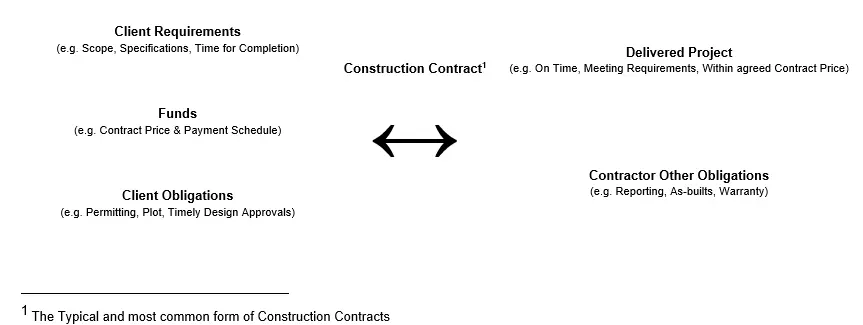
On one hand, a construction contract is, in the broad sense, a mutual undertaking wherein the client has the funds and needs the project and the contractor has the know-how and capabilities to deliver the project within the requirements of the client. This relation can be depicted as follows:
On the other hand, an operation & maintenance contract (or generally any service contract) is a mutual undertaking wherein on one hand the client owns a facility, needs to capitalize on its facility to make the most benefit of it and on the other hand the operator has the know-how and expertise to deliver the intended output from such a facility. This relation can be depicted as follows:
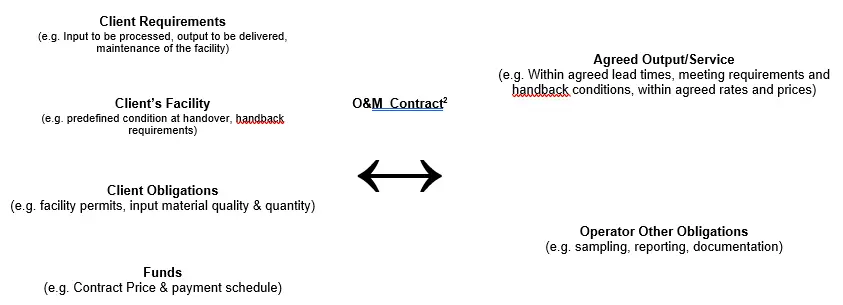
(2) A depiction of a typical and most common form of Operation and maintenance contracts
While in each of those cases the outcome is different; the principle is the same; the contractor or operator’s fulfilment of its obligations is interdependent on the client's fulfilment of its obligations.
In an ideal world, this balance would be maintained and all parties to the contract would fulfil their obligations and as such projects and services would be securely completed on time and within budget. But as a matter of fact such balance is rarely maintained and there are in most cases events that disturb such an ideal balance.
What is the real goal of Contract Management?
As a Contract Management professional, whether you are a client or a contractor and whether you are managing a construction contract or an operation & maintenance contract, the goal remains the same; ensuring that your organization’s rights are enforced and obligations are fulfilled all while minimizing disputes with your counterpart.
Failure to pursue enforcement of your organization’s rights and entitlement could imply “Golden Plating” a situation where your organization could (a) incur unnecessary additional costs, (b) fail to recover losses or (c) miss opportunities to improve profitability.
While failure to fulfil your organization’s obligations could imply the risk of (a) exposure to compensation, penalties and damages (b) losses associated with abortive and remedial works and (c) costs of delay.
In both cases the impact is twofold. First, there are financial consequences through direct losses or missed opportunities for improved profitability. Second, there are commercial consequences when unfulfilled obligations damage relationships and reputations. This affects contractors through reduced client satisfaction and reputational harm, potentially undermining future collaboration. It also affects clients, as a reputation for non-contractual behaviour can increase their project development and services costs.
In a nutshell, it is safe to conclude that the actions and inactions of any organization with respect to Contract Management impact the PROFITABILITY of its projects and the sustainability of its operations.
So whether your organization is building a commercial complex or operating a water treatment plant, Contract Management (or lack thereof) has a crucial impact on the Profitability of your organisation.
Operation and Maintenance Contracts: what are the stakes?
While the principles governing operation & maintenance contracts and construction contracts are similar to a large extent, the natures of these projects are quite divergent.
On one hand construction projects are comparable to sprint races wherein the contractor is racing the clock to complete the construction on time and within budget. Indeed, shortcomings in construction projects are harder to recover.
In construction projects, clients and contractors are in a quasi “Fight or Flight” mode and should ideally remain very rigorous in keeping records and in pursuing their rights and entitlements. On top of that, due to the short-term relationship between some clients and their contractors, these contracting parties may (wrongly) downplay the importance of maintaining long-term positive commercial relationships between themselves.
On the other hand Operation & maintenance contracts are comparable to marathon races, wherein:
(a) The long-term relationship between clients and operators are very often leveraged over the short-term rights and entitlements of operators;
(b) The consequences of any shortcomings of the operator or losses are (wrongly) perceived to be recoverable over the long-term;
(c) Instant production and output are in many cases leveraged over pursuing short term contractual entitlements;
(d) Very often records and operational parameters are automatically captured and recorded by the facility automation system.
Another key difference between construction and operation & maintenance projects being the types and natures of events that occur. Whereas, it is not unusual in a construction project to have numerous events different in nature and impact (in most cases each of those events is a one-off and has finite impact; by way of example severe weather conditions, access blockage and the like). While in operation & maintenance projects, events are often recurrent and have continuing effect (by way of example, frequent deviation in the quality or quantity or input delivered by the client, frequent abstention of the client from enforcing a particular right/entitlement in favor of the operator).
Furthermore, the impact of any such deviation or negative event is generally readily assertable and materialized in construction projects; while in operation & maintenance projects the impacts of any deviation or negative event are generally diluted in the long tenure of these contracts hence downplayed by both clients and operators.
These factors usually give a false sense of relaxation to operators and very often discourage operators from pursuing their contractual rights and entitlements in a timely manner in favor of maintaining a good relationship with clients. But the moment of truth comes when it is time to assess the financial performance of the organization’s operations and then the operators realise the impact of lack of proper management of its Operation & Maintenance Contract.
In a nutshell, in operation & maintenance contracts issues are generally less severe in impact but if they are not addressed at their very beginning they become chronic issues and their impact accumulates over time leading to reducing the profitability of the contract or even worse; resulting in financial losses.
Managing Operation and Maintenance Contracts
The Approach; managing operation & maintenance contracts is mainly about:
(a) Proactively managing the contract by understanding of the technical and operational stakes and covering them (to the largest possible extent) in the contract; and this starts as early as during the drafting of the contract. Past experiences and return of experiences from similar projects are indispensable to foresee issues and events that could be faced during the operation; and
(b) Understanding your contract and identifying any potential ambiguities and pitfalls and acculturating the operations team accordingly; and
(c) Recording and agreeing on the status of the facility at taking-over and identifying gaps between the actual state of the facility and the contract. This includes as well agreement on the expected status of the facility at handback to the client (terms like fair wear and tear may be subjective and can carry many interpretations); and
(d) Resolving contractual ambiguities, as well as any divergence between the facility’s actual state and the contract, between the contracting parties and agreeing on a fair interpretation and contractual process should the relevant event occur; and
(e) Rigorous follow-up of the fulfilment of the parties respective obligations and proper notification of any claimable or relief event; and
(f) Maintaining logs and records for each and every event and every instance in which the parties agreed on a deviation from the contract.
Managing operation & maintenance contracts is all about establishing the rules of the game at the very beginning of the contract; by adopting a rigorous contractual approach and establishing precedents in the application of the provisions of the contract (notably the ambiguous ones). In adopting a contractual approach from the early stages and acculturating the client contractually, any issue or event that would arise during the term of the Contract is highly likely to be resolved without escalation and without undermining the commercial relationship between the client and the operator.
There are many cases in which it may be more pragmatic, for the contracting parties, to pursue continuation of the operation rather than enforcing rights or entitlements they might have , but even these instances should be recorded in writing and should be clearly communicated to the other party as being exceptional and on a without prejudice basis.
The methods and tools; generally Contract Management methods and tools for operation & maintenance contracts are not different from those of construction contracts, by way of example methods like measured mile (as used in construction projects to assess disruption claims) can be used to assess loss of productivity of the facility and associated loss of revenue (or any productivity related financial losses) as a result of claimable event.
Nevertheless, as opposed to construction sites, where conditions are continuously changing, generally (with few exceptions) all operational parameters and records are automatically kept and stored in the automation system of the facility ensuring that all contemporary records are maintained and are generally acknowledged as undisputable facts.
The most important pillar remains the proper understanding of the technical and operational aspects of any contract to adapt the methods and tools accordingly. While, the use of technology in operation & maintenance contracts could be a leverage for proper Contract Management, it is of paramount importance to abide by the provisions of the contract in notifying each and every event and issuing the respective particulars within the defined timelines and time bars.
In conclusion, Contract Management is not exclusively for construction projects, proper Contract Management of operation & maintenance contracts is crucial to maintain the profitability of these contracts for both clients and contractors. Managing operation & maintenance contracts is very similar to managing construction contracts; however, each contract has its own specificities, and a proper understanding of both the contract terms and conditions and the inherent technical and commercial risks is key to managing any such contract effectively.
A propos de l'auteur :
Hesham ELHAWARY
Contracts Director - VEOLIA United Arab Emirates
About Hesham ELHAWARY
Bachelor of Civil Engineering degree with 19 Years of Professional Experience in Africa, Middle East and GCC with vast experience in managing construction contracts for railway, water treatment, infrastructure Project and operation and maintenance Contracts.
Disclaimer: This Article is written in a personal capacity. The views expressed are solely those of the Author and do not represent the views of any organization or employer